Metabolic Dysfunction and Periodontal Disease by Lauralee Nygaard, DDS, MS
Video Transcription:
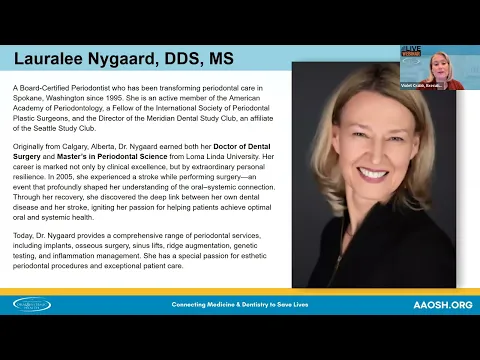
So everybody welcome in. We're so glad to have you. If you will share with us where you're where you're um joining us from and if you want to give a shout out to your practice or your clinic, you're certainly welcome to do so. We are so honored today to have with us Dr. Lauri Nygard who is going to talk today about metabolic dysfunction and periodontal disease. Emily from Nashville. I wish I could say well I will be in Nashville around 5:45 this afternoon. I'm sitting in Phoenix, Arizona right now and I will be home pretty soon. Teresa from Grand Rapids, Michigan. Welcome in. I want to say Danielle, isn't Dr. Nick Ritzma who's on our advisory council? Isn't he from Grand Rapids? I think he's from Grand Rapids. I believe so. Yes, I think he is. Yes. So, if you happen to run into him, run into him and his lovely family, uh you'll know them because I think they have eight kids in total. So, it'll be a very large family when you run into them. So, you'll know them when you see them. Kelly from Grace Lake, welcome in. Allison from New York, welcome in. Yeah, Doy said he is. So, yes, thank you, Doie, for letting me for reminding me of that. I appreciate it. Brett from North Dakota, welcome in. We're so glad to have you, y'all. I came to the desert thinking it would be warm. And there's a Jimmy Buffett song that says, um, "No matter where you go, always take the weather with you." I think people would rather me leave my Tennessee wet, rainy, nasty, cold weather in Tennessee and not bring it with me because when I went to Florida last week, I took 58 degree weather with me to Florida. So, I think people would rather instead of me following that song and just leave my weather in Tennessee. Hey, Don from from Baltimore. Welcome in. We're so glad to have everybody today. We're not gonna we're gonna give it about one more minute. Let folks roll in. We've got a pretty good number already that's made it in here today. We are so excited again as as always to have great webinar series. We have been able to bring you some of the best webinars this year. Um I got to brag a little bit about Accelerate last week and give a um I was then thought you asked uh where I was. I was actually in um Clearwater St. Pete when it was freezing cold in Florida and then I was down in uh Orlando right after that and the week before I was in Clearwater St. Pete I was in Fort Lauderdale. So I've been I've been in Florida quite a bit in the past couple of months and I've still got another trip to Florida I have to make before the year's over. So we're out trying to figure out exactly where um we are going to be having our 2027 shows. I said with an S shows events. Brian from San Diego, welcome in. So, we've got some big big news to share with you. And we're going to do that on our um AOS day of giving on December 22nd. We got a ton of announcements we're going to make during that 8hour socialthon that we're going to have, but we'll talk about that in a little more detail down the road. But a big shout out to Kristen Risner and the entire team on the programming committee that has done such an excellent job of creating great programming this year for us. Uh it is it is so great to um to see just everything that we've just been able to do this year, including all these great webinars. We are so thrilled to see so many great things uh coming down the road for uh for this. And I mean, it's it's truly there's so much more coming. We just can't we just can't put into words how great um the things that are coming even for 2026. We're we're so excited to see everything that's coming. So, let's get let's get started today. Danielle, I'm going to roll over to my notes here and then we'll work our way through the slides. So, a couple of things everyone before we dive in, a couple of quick updates. If you haven't already, make sure you're subscribed to our emails and following us on social media. I just did a go live yesterday. Talked a lot about um about what's coming for a Black Friday sale, which if you don't know, you can go back and actually watch that. It's saved on all of our social media channels, so you can go watch that video. I spent about an hour yesterday, so please go check that out. So, if you're not following us on social media, please do so, and you'll never miss a webinar, an event, or any AOS news. And now, let's talk logistics. Aos is proud to offer high quality continuing education to our community and to help us maintain our alignments. We've got a few important notes. So, if you are watching this webinar live like you are here on Zoom and you'd like to receive CE credit, you must be one an active member of AOS, meaning you have a paid membership. You must log into the Zoom webinar using the same email address you use to register for the webinar. and you have to stay for at least 90% of the hour, which is about 50 minutes. That's it. We take care of everything else. You'll see the credit on your membership transcript within a week after the webinar. If you aren't an AOSH member, you can join today and still get continuing education credit actually for every webinar you've attended this year. So, you can still get credit for all these webinars. Also, if you are an AGD member and you provided your AGD number, you can uh submit your attendance record to AGD PACE on your behalf. We will do that for you if you're the lecture qualifies and this one does. If you're watching this as a recording on our learning platform, these steps don't apply. You'll be granted credit just as you usually do at the conclusion of the course. medical professionals. If you would like to receive CME credit, please email us at supportaos.org and we'll walk you through the process. Now, let's move through the slides that we're required to do for our CE alignment. Let's start with the conflict of interest. So, there we go. The course information, our alignment, credit and support statement, our disclosure of unlabeled use, our information disclaimer, our method of participation, our course description, learning objectives, and practical applications. And let's go ahead and introduce our great speaker today. It is my pleasure to introduce today's speaker, Dr. Laura Lee Nyagard, a boardcertified periodonist who's been transforming periodontal care in Spokane, Washington since 1995. She is an active member of the American Academy of Periodontology, fellow of the International Society of Periodontal Plastic Surgeons, and a director of the Meridian Dental Study Club and affiliate of the Seattle Study Club. Originally from Calgary, Alberta, Dr. Ny Nygard earned both her doctor of dental surgery and master's in periodontal science from Lomolinda University. Her career is marked not only by clinical excellence by but by extraordinary personal resilience. In 2005, she experienced a stroke while performing surgery, an event that profoundly shaped her understanding of the oral systemic connection. Through her recovery, she discovered the deep link between her own dental disease and stroke, igniting her passion for helping patients achieve optimal oral and systemic health. Today, Dr. Nygard provides a comprehensive range of periodonal services, including implants, sinus lifts, ridge augmentation, genetic testing, and inflammation management. She has a special passion for aesthetic periodontal procedures and exceptional patient care. Please join me in welcoming Dr. Laura Lee Nygard. And guys, as we're going through this, if you have questions, share your questions either in the chat or in the Q&A. And also too, use those emoji, the little emojis and reactions. It helps so much in giving our speaker encouragement as we go along. Dr. Nygard, the floor is yours. Thank you so much for being with us today. Well, thank you so much for that kind introduction and welcome everybody. Um I'm honored to be with you this morning uh to present my topic on metabolic dysfunction and parodontal disease. And about um 15 years into my practice, if I was being quite honest, I had been doing everything I was taught in paradol care. And I looked at my hygiene recall department only to feel very discouraged because although I had done multiple rounds of root planning and surgery on my patients, the vast majority of them were in paradal disease relapse and still had residual pocketing. And I kind of felt like, wow, everything I was taught wasn't really working to help my patients have optimal health. And so I started asking myself, what if there was something that I could do that could actually help my patients be well be be healthy? And that's when I sort of discovered this connection between metabolic dysfunction and parodontal disease. And so today, what I'm going to talk to you about is the most common type of metabolic dysfunction in America or actually I would say worldwide. And that is insulin resistance. And simply put, that is when you eat too many carbohydrates for your body. Your blood sugar rises. Your pancreas secretes insulin. Your cells don't respond to that insulin. your pancreas secretes more insulin and you are driven by hunger, fatigue and fat storage. And what's I think a shocking statistic, this is a survey published between 2009 and 2016 showing that 82% of adult Americans are metabolically sick. So just think about that for a minute. If you see 10 patients a day in your dental clinic, eight of them are not healthy. You know, I was thinking about this even in a hygiene area. Let's say you see six or seven patients a day. If you see six patients a day, 4.9% of them are not metabolically well. And if you see seven patients a day, 5.77 of them are not metabolically well. So this has huge implications in what we're able to do with our patients to help them achieve optimal health. And metabolic syndrome or insulin resistance is characterized by having three or more of the following um presentations. So if you're a man, your waist size is greater than 40 in. If you're a woman, your waist size is greater than 34 in. Your hemoglobin A1C is 5.7 or greater. And your fasting blood sugar is over 100. Um, in addition, you would have blood pressure that's greater than 120 over 80. One of the hallmarks of insulin resistance that doesn't get a lot of traction is high cholesterol, in particular, high LDL, high triglycerides over 150, and low HDL is actually a marker for insulin resistance. So, at the root cause of cardiovascular disease, insulin resistance or metabolic dysfunction plays a gigantic role. So onethird in addition I would say one-third of normal weight adults um only one-third actually of normal weight adults are metabolically healthy which means if you're a normal weight don't think that you get off scot-free um because these are my lab results so I am skinny and little and I've always looked like I was healthy and my hemoglobin A1C topped out at 9.2 too. Okay, so there's something called thin on the outside, fat on the inside, which means that even your healthylook patients, um twothirds of them may likely be metabolically sick. And what's very interesting, and if you're if you're looking for a great book to sort of get your um understanding of insulin resistance, I really recommend the work by Ben Bickman. Um, but this book really helped me understand that insulin resistance actually develops in our country and in our population about 10 years before you're ever diagnosed with type two diabetes. So, it really is a silent killer because the damage is continuing almost a decade before we're actually getting treatment for patients. And so what's different between insulin resistance or type two diabetes is in insulin resistance your labs if they only look at glucose are going to look normal but your insulin levels can run three times normal for 10 years before you're diabetic. And then what finally happens is as you've been stressing your body out overeating carbohydrates and and um causing your cells this challenge to try to process all this extra energy. um everything gives away and when you finally get a diagnosis of type two diabetes, not only is your insulin level running high, but so is your glucose level now uncontrolled.
And most often what the lab tests that are done to diagnose insulin resistance are something called an oral glucose tolerance test. So for those women joining in the webinar, you know, you've all done this if you have ever been pregnant. So, this is where you drink 75 grams of sugar and um you're at the lab for two hours and they test your blood at fasting, at 30 minutes, at 1 hour, and then at 2 hours later. And the goal is at the end of that lab test, if your blood sugar is less than 140, you're considered normal. If at two hours your blood sugar is um less than 200, you're considered pre-diabetic or greater than 140. And then if you're over 200, it means you're a full-blown diabetic diagnosis where you're not being able to regulate any of the sugar. What's interesting though is this study by um Chilei found that if you're just relying on a hemoglobin A1C um you could be missing a significant amount of um diabetic patients. And so this study looked at 501 patients that were screened for pre-diabetes by doing a glucose oral glucose tolerance test. At the same time of doing that oral glucose tolerance test, they did initially draw a hemoglobin A1C And they found that of those 500 patients, 193 of them had impaired fasting glucose or impaired glucose tolerance or were pre-diabetic. And that if they just looked at the hemoglobin A1C marker, it missed 90 of the pre-diabetic patients. And this was statistically significant. So they found that this oral glucose tolerance test can actually miss a diagnosis of insulin resistance and pre-diabetes in almost half the cases. So you don't want to just rely on a hemoglobin A1C for metabolic health. And so this is one of the I guess challenges I have found trying to work with my medical colleagues is that they really in terms of this metabolic dysfunction um there's a a lot of opportunity to help people get well when we're kind of not paying attention. So, for example, in the medical community, I have patients that I see every day whose A1C is around six or 6.4 and they're told that they're not diabetic. They're told that they're normal. Even if they're their fasting glucose is above 100. And I think what we should actually be asking ourselves is what is the difference between metabolic health and metabolic dysfunction? Because if the goal is us is for us to be healthy, how would we why should we accept that we're okay with being unhealthy in a pre-diabetic state when there's there's a lot of damage that can happen? And so what I tend to talk with my patients about is looking at the difference between metabolic health and metabolic dysfunction. And so I think the numbers need to be much tighter. So, for example, you're considered metabolically healthy if your hemoglobin A1C is actually less than I would say 5.4. I think even 5.7 is a bit generous. And you really want your fasting blood glucose to be around 80 89, but solidly below 100. That means that you're metabolically healthy. anything um below that line uh is basically metabolic dysfunction and requires um I would say significant lifestyle intervention and education on the damage that can happen to your body when you're living in this um metabolic dysfunction state. So some of the other standard labs you can use if you're interested just looking at your own numbers uh you can actually use uh a basic metabolic panel but that's not enough to test for insulin resistance. You have to also request that your physician does a fasting insulin blood draw. And that is not part of our standard metabolic panels within the medical community. So it's it's I think why there's a large lack of understanding between physicians in terms of what is metabolic health and what is metabolic disease and where to intervene. So you can you can calculate this on your own. It's called a homoir score and it's where you're looking at fasting glucose times fasting insulin divided by 405 and it will give you a metabolic health score. So if you're insulin sensitive, which means metabolically healthy, uh the number should be less than 1.5. If you're in poor metabolic health, your number would be 1.6 to 3.9. And if you're pre-diabetic, you're going to have a score that's four or greater. In addition, you can actually use a cholesterol panel to evaluate whether or not you are uh insulin resistant. And you can take your triglyceride number divided by your HDL. And if that number is lower than two, it means you're metabolically healthy. If that number is greater than two, it means that you're pre-diabetic or insulin resistant.
And one of the things when I read the book by Ben Bickman, he really helped connect the dots because in the in the paradol space for the last 15 years, we've been told there's all these connections between oral health and systemic health. And I could never really understand why. It never made sense to me. You know, even this whole idea that well, a bacteria can get your bloodstream and cause a heart attack maybe, but how does it get into your bloodstream? So, I really found that the whole insulin resistance or hyperinsulinemia root cause really explained a lot of these things and and uh Dr. Bickman, he calls them the plagues of prosperity, which are the most common illnesses of insulin resistance. And these two graphs kind of like overlaid and lit up for me where it made a lot of sense. So, in other words, if you're insulin resistant and your insulin levels are or you're eating a lot of highly carbohydrate-based foods and your insulin is is running high, insulin will actually affect blood vessel integrity. It causes your blood vessels to leak. And so, if you have leaky blood vessels, you're certainly going to be at more risk of a stroke. you could definitely be more at risk of respiratory infections because anything that you're breathing in is going to have a chance to um have gain more access. You're also when your insulin levels are running higher and your sugars are higher, your immune system is not as regulated. So respiratory infection would be more common. Um there is an impact with um bone health in terms of insulin resistance. Lowterm and birth or low preterm and low birthweight babies is interesting. If the mother is undernourished, the baby will become insulin resistant as a protective mechanism so the baby can still grow. Um, and then heart disease. Obviously, there's been a lot of discussion about parallel pathogens, but again, at the root cause of cardiovascular disease, which is often not talked about, is metabolic dysfunction. Oftentimes, the first sign that you might see that you're metabolically unhealthy is your cholesterol goes up, but most physicians don't talk to you about the root cause of that illness. And then certainly we're all familiar with uncontrolled diabetes in the paradonal disease space. So the work of Dr. Kate Shanahan really put it all together for me because she uh in her work I read I found this study. So this is um circulation research and this found that when blood sugar levels go high that high blood sugar activates uh protein kyna C and protein kyna C is part of the enzymes that help regulate endothelial single cell integrity. And when blood sugar levels go high and protein kyna C increases it basically causes your blood vessels to leak. And so the light bulb went on for me in terms of um paradol infection because if my patients are yo-yoing sugar all day long in a mouthful of paradol pathogens and their blood vessels are leaking then truly you're going to um create direct damage in the endothelial lining of all of those uh gingible blood vessels and then you're going to allow parallel pathogens direct access. So, this idea of leaky pockets is completely tied to someone's nutrition and their insulin um metabolic health and the ability for insulin to regulate the things that they're eating. And interestingly, blood sugar levels at at 89 will cause the activation of protein kynise C. you know, like I see patients whose blood sugar levels are well over a hundred almost a regular basis. And so, um, realistically, they're doing a lot of damage that they might not even understand because they're told by their medical colleagues that as long as their blood sugar is 100, they're not diabetic and that they're healthy. So, in addition, the foods that we eat matter and the work by Dr. Um, Robert Lustig is quite interesting and he his work is in this space of how sugar affects our metabolic health and in particular how high fructose corn syrup affects our metabolic health because your body does not burn fake sugar in the same way that it burns real sugar. And interestingly, fructose cannot be metabolized by your cells. So when you are exposed to high fructose corn syrup, it is stored in your liver immediately as fat. And this is part of why it increases your risk for obesity, type two diabetes. It's also why we're seeing non-alco non-alcoholic fatty liver disease and hypertension because we have largely done an experiment on our population by using um fake food for the last 30 years. And it turns out that high fructose corn syrup is even more metabolically active than just sugar. And I think even more interesting or Dr. Leig talks about this is 72% of processed foods in the United States contain sugar. Most of what you buy in the grocery store is actually not food if you define it by this idea that we can't actually burn high fructose corn syrup. So it's not a molecule that gives us energy. And if food is something that should provide energy and we're eating a lot of ultrarocessed foods, most of the foods that we're eating, if they contain high fru high fructose corn syrup, are not providing us any nutrition. And Dr. Lustig's recommendations are that we should have no more than 12 grams of added sugar uh daily. And one teaspoon of sugar is four grams of sugar. So that means that we should be having no more than one teaspoon of sugar per meal to be metabolically healthy. Now let's just talk about what that looks like because most of us are pretty familiar with these types of sugary drinks. So apple juice, which I thought was a health food when I had kids and was feeding them way too much apple juice in only 8 ounces of apple juice is 25 grams of sugar. Uh when I had my stroke, I drank a strawberries and cream frappuccino for lunch. And uh there's a whopping 51 grams of sugar in that. And I'm quite certain that the bolis of sugar that I ate probably caused my brain blood vessels to leak and very likely could have had a role in my stroke that I suffered. In addition, soda that we tend to think is just part of a meal. Uh 39 grams of sugar in just a 12 ounce serving. So it kind of puts in context how we're being exposed to excessive amounts of sugar that's derailing our metabolic health and we don't really even notice it. So insulin resistance is metabolic dysfunction and um basically that's what happens when you eat too many carbohydrates. Your pancreas secretes insulin. Your cells don't respond to that insulin. So more insulin is produced and there's excess sugar that's not being stored in your cells and so your body puts it immediately into storage either in your belly or your hips as fat or the more metabolically active fat or in your liver or you can get fatty liver disease. And if you uh put your system under stress for long enough then you will end up developing type 2 diabetes. And this is what I think is beyond fascinating is your body can only at any given time handle four grams of sugar in your bloodstream for a an average person. So for a 70 kilogram person, you can only have four grams of sugar floating around in your bloodstream. So wow, like when you think about the amount of sugar that's in foods that people consume all the time, it's no wonder we're fat, sick, and sluggish as a nation. And we're also taught that foods that contain sugar are healthy. So, for example, life cereal, 8 gram, which is a 3/4 cup serving. I don't know of anybody who eats that little amount of cereal. That is um 8 gram of sugar in the cereal. A granola bar is 11 grams of sugar. Uh things that we think would never contain sugar. So, for example, a tablespoon of salad dressings, two and a half grams of sugar. Um ketchup, four grams of sugar in one tablespoon. And then barbecue sauce, six grams of sugar in one tablespoon. And we all know very well that this is not news in the dental community, but Dr. Weston Price was the first person to really document how nutrition not only impacts dental development, but drives dental disease. And he found that traditional diets where there was not a lot of sugar or processed grains all had a higher amount of fats soluble vitamins. So vitamin D, vitamin A, and vitamin K. And so it's very imperative that we make sure we're getting healthy fats. And so um we need healthy fats in particular to be able to onboard calcium into our teeth or in our bones. So it's very important and unfortunately we've been taught to avoid these foods and so I think again it affects our dental disease status and our dental development and there's quite a there is literature even the parodol um this is journal of perodontology. This is the impact on a stone age diet on gingerville conditions in the absence of any hygiene at all. So no brushing or flossing. And so this was 10 subjects. They were put into a stone age enclosure for four weeks. Four weeks was chosen because if you remember 3 weeks is when you can sort of stimulate um experimental gingivitis. And they were fed only whole foods that would be seen in a stone age diet. So nothing that was processed and no sugars. They did not have any toothbrush or any flosses. And before they went into the study, they tested bleeding on probing uh plaque scores. They tested their plaque for bacteria and for carries. And then after a month when they came back out, they tested again bleed on probing plap scores and uh the presence of the different pathogens. And one of the things that they found that was very interesting in the study was there were actually higher levels of bacterial pathogens on the teeth but lower levels of inflammation. So it it it kind of um their conclusion was if somebody's eating a whole foodsbased diet, the idea that doing an experimental gingivitis study to test things may not be as effective because they were not able to induce experimental gingivitis in a four-week period of time in the absence of western processed foods. So insulin resistance is linked to paradol inflammation. And so in this study, this found that people that had higher insulin resistance scores also showed higher bleeding on probing levels and that they u looked at the insulin resistance scores by calculating the homoirs on those patients. So, another really fascinating thing I've seen in my patients on GLP-1 uh weight loss drugs is I see significantly more gentle inflammation. And I think it's because these drugs work to make the body produce more insulin in the presence of carbohydrates. And I really think that sugar is not where the damage happens on the paradonal foundation, but I really believe it comes from the high insulin levels because insulin is an active hormone and has this very um direct ability to cause endothelial leaking. I think that on that's what I'm seeing in my patients on the GLP1s. I had one patient in particular who actually stopped her GLP1 and her gingible inflammation completely improved. Um so you know I think the jury's out on this. There's not any data, but this is just my clinical observation, and I think it makes sense when you look at the destructive uh nature of excessive insulin levels. You'll definitely see more bleeding on probing in patients whose insulin levels run high. And so I often talk to patients about this idea that if you know, if you're eating um multiple doses of sugar in the day and your insulin is running higher, you're inviting her pathogens into your body to establish disease and create damage um via a leaky pocket. So that's something that they have a lot of control over. And um when I talk to patients about the lifestyle uh connected to paradol disease, they often tell me no one's ever talked to them about this. And when I have them make some small lifestyle changes, it is amazing the impact they can have on reversing their disease states. So as I was learning this, and this is something you can sort of pay attention to in your practices, I started observing after the sugar holidays, there was always more bleeding on probing in my hygiene patients. And I would ask them, hey, you know, did you eat a lot of Easter candy this weekend? Or did you have Valentine's treats this weekend? Or did you? And invariably they would all say, yes, yes, I did. Um, so there's so I was also, as I was learning about the science, I was starting to see practical um commonalities in my patient population, kind of showing this to be true. So um pre-diabetes and insulin resistance is associated with parodonal damage and uh glycemic control can reduce the severity of parodontal disease. In the same way the risk for severity of parodonal disease increases with poor glycemic control.
And so I tend to think about when I'm staging and grading a paranal disease patient, even if they're not a diagnosed diabetic and I know they're hemoglobin A1C, it's going to affect how I'm going to grade their disease progression. So another really interesting thing I came across was that the lipopolysaccharides from P gingalis in particular actually can influence the beta cells directly to stimulate the secretion um of insulin. So they postulate in this study that pentalis may actually be a trigger to the development of diabetes by its direct impact on the beta cells. And so for those of you that do any kind of um saliva testing or bacteria testing if you see that pigeon develis pathogen present think in your mind likely insulin resistance pre-diabetic or on a speeding train to become diabetic. So this I love this study because this research is not just in the paradol literature. It's all over the place in science and I think you know any concepts that can be validated in multiple disciplines are just much much stronger. And so this is a journal of clinical endocrinology and metabolism and what they published was that severe peral disease was associated with insulin resistance in normal weight patients. So high homoIR scores at baseline had significantly higher numbers of sites with bleeding on probing and a higher number of teeth with probing pocket depths greater than 4 millimeters even at their follow-up. So even after treatment than individuals that were more metabolically healthy or had lower home scores. So the endocrinologists if they're reading their journals should be aware that this is something um in the dental community that we can help them with. And that's just a summary of that study there. So why is this important for the dental team? So here's what I believe our role is in the dental team in metabolic health. First and foremost, I think you should know the signs of insulin resistance so you can identify them in your patient. So things like high cholesterol, high blood sugar, is a patient tired after they eat, are they gaining weight, especially especially belly fat, do they have skin tags, acne? uh goat is the ghrein ot trans o acetyl transase enzyme and that is what's going to drive you to be hungry all the time. So um when I was sick and my A1C was nine I will tell you that I could eat and I could eat again and I never seemed to be able to get enough food and because I was skinny nobody ever questioned they just thought I had a high metabolism. The other thing that's very interesting is a sign of insulin resistance that doesn't get a lot of uh I would say attention is low blood sugar or people that go, "Oh, I'm just hypoglycemic." Well, if you're hypoglycemic, you're insulin resistant because that is a sign of poor metabolic dysfunction. Low muscle tone is a sign of insulin resistance. Sweet cravings, if you're somebody who needs a sweet treat after every meal, you're insulin resistant. If you have fatty liver disease, you're insulin resistant. PCOS, again, fertility issues, all insulin resistance. So these are things that I think in our medical history reviews we should be comfortable knowing about and then talking with our patients about that. So some of the oral signs of pre-diabetes u burning mouth syndrome candida infections angular keitis altered tastes and foods um bleeding gums are definitely a marker for insulin resistance. Uh so just having somebody that comes in where their gums are bleeding even in the presence of normal pocketing let's say with a lot of gingivitis um one of the lifestyle things you should think about is what's their insulin number look like and then bleeding on probing and probing pocket dubs greater than 4 millimeters are are also markers for insulin resistance and again this is in many different published papers showing the correlation. Um, this is probably something you haven't thought about, but again, there's a lot of data on this is that there's a correlation between tooth decay and insulin resistance in normal weight patients. So, if somebody comes in and they're constantly having decay, they feel like um the literature showing the reason they think that this occurs is they think that insulin interferes with um uh dentin and its ability to repair itself. Um, and this study looked at using a supplement called myioininotol that could help uh support um dentinal health and maybe be used as a supplement to reduce uh dental carries. And so the study found that there might be some promise in the supplement and additional studies are needed. But again, I don't think it's something in dentistry that we're taught about when you see a patient that comes and it has cavities all all around. I even know many dentists that don't even bring up a diet conversation with patients with multiple decay. Um, and I think it's quite telling that a lot of our patients don't even understand what sugar is. Again, another oral sign that you'll see is um, erosive esophagitis or um, acid reflux is a symptom of being pre-diabetic or insulin resistant. And that's again something that you might see dentally and can have a conversation with a patient about. Um, some of the other extraoral signs that you might just see when you're meeting a patient is athosis nigricans, which is a velvety darkened patch. Usually you can see around uh the neck. You'd see it around the neck in the dental office. Uh it can also be under your armpits. Um but generally you would see it around a patient's neck. Skin tags are a symptom of insulin resistance as is cystic acne and you might see that in some of your patient populations. So high blood pressure is a symptom of insulin resistance. So if somebody's blood pressure is running um high, it can be a marker um that they are insulin resistant. And because we take more blood pressures because of local anesthetic than even most medical offices, again you have an opportunity to use this as a screening tool to help um start that conversation with your patients. So in this study uh in hypertension, this showed that if the blood pressure was 130 over 80, it was linked to insulin resistance. This is in patients that had no history of diabetes.
And then for those offices treating sleep apnnea, there is a connection between obstructive sleep apnea and insulin resistance. And uh this looked at 270 patients. 185 of them were diagnosed with sleep apnnea. They looked at fasting insulin levels. Each apnic episode increased insulin resistance by half of a percent. Obesity and age were also correlated with insulin resistance or increased insulin resistance. And so apnea was found to be an independent determinant for insulin resistance. So again for those offices that are making appliances and talking to patients about sleep, I think this really is the other thing that has to go hand inand is an education for patients to how how to with lifestyle work on managing their insulin resistance or reversing their insulin resistance. So how does this practically look like in a a patient you might treat? So this is my patient. Um, she is a 68-year-old female. She's single, retired, has two cats, and she's committed to working on her health. So, in her dental history, she has been through two rounds of orthodontic treatment. She has a lower bonded retainer and an upper clear retainer. She has a previous history of parodonal oius surgery, laser surgery, without any follow-up cleanings. And she's using her sonic care two times a day. uh in addition her hydrophoboser three times a day and she's back in my office uh for paradolon consultation. So her medical history she has no allergies her blood pressure is 162 over 89 pulse is 65 she has notes she was diagnosed as pre-diabetic in 2001 her most recent hemoglobin A1C is 5.6 six. And so, right out of the gate, before I even do my paradonal exam and I've reviewed my patients medical history, I'm thinking metabolic dysfunction. And here's two reasons why. One is her A1C, which is not optimal. Metabolically healthy patients are going to have a hemoglobin A1C of 5.4 or lower. So, she's on the line. And then her blood pressure is too high. So if her blood pressure was normal and her and her like if her blood pressure was 120 over 80 and her hemoglobin A1C was 5.6, I probably would think that's okay. But with her hemoglobin A1C being 5.6 and her blood pressure being high, it's a very good sign that there's some stress on her endothelial lining of her vascular system and may in fact be a marker for some metabolic dysfunction. Her current medications are for thyroid um for herpes outbreak. She's on hormone replacement therapy, Moxym, alprazilum for anxiety, odenastron for nausea, and history of actel. She's 5 foot n 170 pounds. So here's her front smile, her profile smile, close-up front smile, retracted closed. You can see the inflammation along the gingal margin. It's just a bright red line.
And then again you can see the rolled gingal margins and the inflammation um in the preolar and canine and molar areas. Here's her left closed and left open. Again you can see the rolled margins and inflammation. Here's her maxillary accusal view, her mandibular occlusal view. And here's her paradonal findings. So, uh, you know, paradonally, she's probably, honestly, I would bet a lot of people watching this might see patients like this and see them for a proy and not think twice about what's going on. Um, but she's in paradol disease relapse and with her history, this is quite a concern in terms of the systemic risk that it might be. So, um, she also shows 15 to 33% or moderate bone lice generalized. Um so in her diagnosis staging and grading she would be perodontitis stage two and her grading uh is a grade B because she's hemoglobin A1C less than seven. Um so an interesting thing I came across as well is when we're talking about staging and grading I always wondered how smoking had effect and people always told me it was about basil constriction but it's actually about insulin. Smoking has a direct effect on insulin resistance. it makes you insulin resistance and insulin resistant and in particular all of the um toxins that are in in uh cigarettes tend to have a direct effect on um insulin levels and endothelial dysfunction and lipid metabolism. So it's it is again at this root cause about metabolic health I I believe it and the role of insulin. And so what I tend to now think about when I'm applying metabolic health to staging parallel disease is I think about a rapid rate of destruction in terms of the parodonium would be in a diabetic patient whose hemoglobin A1C is um 6.5% or higher. I think of a moderate rate of um damage in a pre-diabetic patient whose hemoglobin A1C is 5.7 to 6.4. And I think about someone who's a slow rate of disease progression. if your hemoglobin A1C is 5.7 or less. So I'm looking at trying to correlate metabolic dysfunction with the rate of attachment loss that I think I'm going to find in patients. And so um it is very clear that pre-diabetes does increase clinical attachment loss. And and where I see the most damage in patients is in this 5.7 to 6.5 range because they're told by their medical health care providers that they are healthy. They are not told that anything about being metabolically sick or on the speeding train to become a diabetic. They told that them that they are fine. And in this range is where I tend to see the most paradonal destruction. So pre-diabetes is associated with perodontal disease. Um and in this study the summary of this found that it early diagnosis of pre-diabetes is critical to avoid irreparable damage that occurs in parodontal disease. And I really feel like um our in the dental community with our hygiene and our dentists, we really should become the first line of diagnosis in metabolic dysfunction because we see our patients more often. We're doing screenings that make it easy to identify and just like airway is now solidly in our um toolbox to manage for patients, I believe metabolic health is as well. And so what I've started doing in my patients is I orders a test through Quest Labs called Cardio IIQ. And I did this for the patient I just shared with you for Patricia. So we ordered a cardio IQ test because I was suspicious that she was not metabolically healthy. And here's what we found. So I love this test because it gives you a range of optimal metabolic health, moderate metabolic dysfunction, or high metabolic dysfunction. And so I was not surprised because she got a score of 33 which shows that she has, you know, she's not terrible but she's not great. And so her insulin resistance and metabolic dysfunction is probably driving her recurring paradontal inflammation.
And so Patricia's treatment plan uh we didn't have to do any acute treatment. Uh we were going to do four quadrants of root planning, work on some metabolic uh health coaching. We'll do a lab test of Riaal and then we'll follow up with a cardio IIQ test, see what her insulin sensitivity is and then maintenance is going to be three month recall lifetime and annual carries exams. So what I will do for patients is educate them on how to manage their um blood sugar levels. So glucose revolution is a book that I'll recommend and the really the hacks are before a meal you can drink a tablespoon of apple cider vinegar mixed in eight ounces of water through a straw. that can lower your blood sugar. When you're eating a carbohydrate meal, you want to eat food in the right order. So, green veggies first, protein next, fats third, and then carbohydrates last. It will lower your blood sugar. And then you want to always put clothes on a carbohydrate. So, never eat a carbohydrate between meals or without a fat or protein. And finally, move. Even just doing squats will help um improve metabolic function. And then the Freestyle Libre um glucose monitor is one that I do prescribe to patients that are interested. Um but you also now can order them directly to to consumer as long as the patient is not on any diabetic medications. Um you can order these. It's called Stella by Dexcom. And um they're I think they're just over $100 a month now to to um see what's happening for metabolic function. And I do recommend these to patients quite often as well. um when you prescribe as a dentist um so here's the way I prescribe it two different ways so if the patient's pre-diabetic um I will um and the freestyle libre 3 is the new scans um but there the medical code is ICD 10 KO56 and that's for uh paradonal disease related to diabetes and I will usually just on this script per uh prescription to the pharmacy put that I am requesting labs um and that are doing this secondary to high blood sugar. And then if they're full-on diabetic patient, so I've had some diabetic patients whose MDs will not give them glucose monitors. And so I will prescribe them with a code ICD 111.630 and that's for diabetes type two with paradol disease so that they can actually get their blood sugar better under control and improve their paradol uh inflammation. So, the next thing I'll tell a patient is you want to avoid drinking liquid sugar uh because it's just a baseball bat to your pancreas and it's not good for any dental health. You want to drink clean water um half your body weight in ounces daily. So, if I weigh 100 pounds, I want 50 ounces of water for base hydration. You want to avoid processed coffee creamers because they're full of seed oils and their uh sugars in general and so those will cause inflammation. And then I tell patients to avoid processed foods. Limit flower plant-based foods and try to avoid fake oils. Um, eat a whole foods diet. Try to avoid things like flower-based foods, pastas, grains, crackers. That's a really hard one for people to wrap their head around. But if they're willing to eat a more paleo-based diet, the inflammation reduction is remarkable. And again, we've got the Stone Age diet to kind of show that we do have the power to heal our paranal health uh through diet. And eat healthy fats. Butter is my favorite dental fat because it's the right mix of vitamin D, vitamin K, uh especially if it's grass-fed butter, um to help onboard calcium. So, it's usually what I'll have patients try to cook in and eat more of. Uh I like the dental diet recommendations. So remove vegetable oils, remove white flour, remove sugar, remove packaged foods, avoid artificial or fake sugars. They do raise insulin, so that's why you want to avoid them because of the negative impacts of spiking insulin. You want to do full fat dairy if you can tolerate dairy. And limit fruit to two to three servings a day. Fruit is not a get out of jail free card for sugar. I know this for a fact. I wore a glucose monitor. I ate a green apple with almond butter and my blood sugar went almost to 300. I about fainted. I I it's it went as high as when I ate cake. So for me in my metabolic health, fruit is not a great option and and of course alcohol in moderation. So here's Patricia before we um talked about lifestyle intervention, got her on a glucose monitor and here's her after. So you can see a pretty significant reduction in the gingal inflammation. Uh here's her before and after. And you can see that rounded margin is starting to improve and heal. Things are getting healthier. And here's her before again and after. And so the dental team in metabolic health uh spread the word. I think this is something that um just educate your patients on how diet really does affect their paradal inflammation. Um know for sure that if you see bleeding gums in a patient, think metabolic dysfunction or high insulin levels. Even if they're healthy, they're just eating too much junk that's elevating their insulin and so they're getting leaky pockets. So by limiting the amount of processed carbohydrates, eating more real foods, drinking things that aren't liquid sugar, they can reverse that inflammation very easily. And then um I would say for all of us, focus on metabolic health for parodontal health. Eat for nutrient density. So avoid junk food, eat whole real foods. My favorite cookbook um from Sally Fallon through the Western Price Foundation is Nourishing Traditions. Um wear a glucose monitor. I think I think everybody should do this for three months. One thing that my journey has taught me is there's not one diet for everybody. And I really feel like we are so biologically individual. Know what foods f fuel you the best and wear a glucose monitor. Optimize your sleep for optimal metabolic health. And know your numbers. And remember, it's not enough to know just your blood sugar levels or your hemoglobin A1C because you might look okay on a hemoglobin A1C, but you might be 50% of those uh more metabolic dysfunction cases that are missed. So, you can calculate your own homoir score. I remember that you take a fasting insulin times fasting glucose, divide that by 405, and that will give you a homoir score. And your goal should be to be in the uh insulin resistance range or insulin sensitive range optimally. or to be below the insulin resistance range. And then know your triglyceride to HDL ratio. So this is another one um that you know high cholesterol doesn't need a statin. It needs lifestyle intervention. You need to get your insulin under control so that you're not metabolically unhealthy. So no, you want to have um an a triglyceride to HDL ratio uh under two, which usually means you're insulin sensitive. And then remember only one in eight Americans are metabolically healthy. So you have a lot of opportunity every day, not just with yourself and your teammates, but with your patients to help educate your patients on the um connection between metabolic dysfunction and parodontal disease. So thank you so much for joining us today and I will hang around for a few minutes if there's some questions.
Wonderful. Thank you so much. Wow, that was really great. Especially someone um like myself who doesn't have any medical medical degrees. Um it was very eye opening.
Yeah, just like just like they said in the chat. Eye opening. Absolutely. Um there is a couple I did see someone said can you share some phrases you commonly use with patients to share this knowledge? So, I would say a couple so a couple of them. Uh, one I'll I'll if I will say to patients just so you know, I'd like to talk to you about what lifestyle things you can do to help prevent tooth loss. And I don't try to inflict it on people. So, the one thing I've learned with this, um, not everybody wants to hear this, you know, um, it's very interesting to me how addicted we are to our garbage food in this country. And so, if somebody is resistant, I don't push it. But if if somebody, you know, if I say to them, are you interested in knowing what you could be doing so that you have better um success rates on your treating your gum disease or on limiting tooth loss? If they say, "Yes, I'd like to know," then I will give them lots of resources. Um I would say in a more simple way, let's say I see somebody that's getting cavities. Um well, here's an example. I had a an elderly woman this week who is her mouth is on fire. She's just hurting and hurting. And I said to her, "Can you tell me what are you eating?" And she says, 'Well, I drink apple juice all day long. And I said, 'You cannot have any liquid sugar. We are never going to control your what's hurting you in your mouth with liquid sugar. And she goes, "Well, is Gatorade okay?" And I'm like, "No." I'm like, "Liquid sugar?" So, we literally, here's what I found out she was doing. Apple juice all day long, Gatorade, sucking on Tootsie Rolls, eating Ritz crackers covered in chocolate, wondering why her gums are red and sore and inflamed. And so she had no idea that she was eating foods that were causing this. So I said, "Okay, between now and I see you next time, no liquid sugar." And she's like, "What about ice cream?" I said, "No sugar." I said, "You can eat meat frozen sugar and vegetables. You can have black coffee or black tea, no liquid sugar." And I said, "We're going to see where you're at in a few weeks." And then I ordered an insulin resistance test for her because I would bet her her in her um A1C is 11. And so I I don't know if that I hope I answered that question. I think just in general I I will talk to patients about paradol disease, you know, is an inflammatory condition that is not just about uh brushing and flossing because the people I see as a paradonist brush and floss all day long. They have the best home care of anyone. So that they still have this problem. And I say at the root cause of this destruction is actually metabolic dysfunction. So if you're interested in knowing what that connection is, I can give you lots of resources. We can work on things baby steps at a time. And I would say what I try to do first is just have them not drink liquid liquid sugar. So I'll say please try to optimally hydrate your body which is half your body weight in ounces of water a day and no liquid sugar. And I'll say what do you like to drink? And then they'll tell me and I'll say no. Oh this elderly woman too was drinking wine on top of everything else. And I'm like I'm sure she's a metabolic too. Right. Well you totally can but the but you're again it's not that the liquid sugar is terrible. I mean it is terrible but I teach them how to do it. So, if you're going to have liquid sugar, first of all, don't sip it slow all day long. You have to eat it after a meal. So, if you eat it at the end of a meal, you're not going to spike your insulin as high. So, if you have to have that soda every day, then you eat it at the end of lunch and then nothing in between so your body can um you know, buffer the acid, buffer the sugar, and you can give your liver and pancreas a chance to recover from everything that you've just done. So, and again, uh amount matters, right? Because if you looked at the grams of sugar, let's say in a 12 ounce soda, why don't you do a little soda? Like, if you're going to have to have it, you can limit. So, so I try to be practical. I mean, not everybody is going to I'm very strict because I I have had to be to heal myself, but not everybody is going to be that strict. So, it's kind of trying to understand what they're doing and helping them figure it out. I had another case where he was sucking on uh Teddygrams all day. He was a male carrier and eating Teddygrams constantly and thinking that was fine. Like literally a whole bag of Teddygrams as he's walking around mindlessly. So I said, "Okay, you can have the Teddygrams, but they have to be at lunch, after your meal, and no snacking in between." And so little changes like that can be wildly impactful on managing gum inflammation. It's incredible. Um, I got another one that said, "What resources do you like to point to?" I know you picked out a couple that you showed us earlier if there were any more. Oh, I have lots. So, uh um it depends. If it's a man, let's say, I love to direct him to, uh Kenberry on YouTube. Kenberry, MD, has a bunch of really practical, common language videos on how to reverse insulin resistance. He also wrote a book called Kicking Ass uh for men in particular. So, that kind of helps men get engaged. Um I would say uh I love um Glucose Revolution to help people understand about you know how insulin is a factor. Um but I would say um most people in terms of resources will just try a few of the things that I recommend and when they see they're working they just they get excited about continuing. You know you don't have to have a zillion resources. Um there are you know I love but they're kind of sciency like Kate Shanahan. I love her stuff, but it's a little bit sciency for people. Um, you can also follow Level's Health, which if you want a glucose monitor with coaching, that's a program where you can actually sign up and they'll do labs. They'll actually send you the glucose monitor and then they'll give live coaching. Dr. Philip Ovedia also has Ovedia Health, which is an online coaching program for metabolic health specifically. So, I have lots of resources um depending on how much somebody wants to do or doesn't want to do. I actually in my office I have a book list I give out to people which is probably got 30 books on it that are all in these different topics where they can research them and read.
Wonderful. Yeah, that was great. Um I don't see I don't think I see any other ones. Let me just double check. Uh I know somebody commented said that they couldn't click on the Q&A. I'm not sure why you were having that issue. It does say that it's opened all, so maybe it was just a Zoom glitch or something. Um, let's see. And someone say, go ahead. I was going to say too, my email address is there, so if people had questions, they could just email me directly. Yeah, feel free. Um, someone did say, is GLP1 oz? And I don't think so. Right. That's just a brand, right? Like band-aids. Well, it Yeah. So GLP-1s are like a like of an umbrella term. So OAMPIC is a GLP1 injectable. Yes. Got it. Um I think that's it. All right. So if there's any other last minute questions, people can pop them up. I'm going to put up the QR code to become a member if you're not a member. Um because everyone here, as long as you stay this long, you will get the credit. Um and you're a member. So I'll pop that up. So if you're not, there's also a code. will give you 30% off for signing up to be a me member today is going to be learn 30. Let me just put that up real quick.
Always text us.
All right. Okay. So, um, unless anybody has anything else they'd like to ask, they'll double check the chat.
Oh, I don't believe so. So, thank you everybody. Thanks for joining us. We're actually going to end rightly on time. Thank you um Dr. Laurley for um having this lecture with us today and um I hope to see everybody again at the next one. Thanks everyone. Have a great weekend.