Neuroplasticity in Practice: Where Dentistry Meets Brain Health by Liz Lundry, RDH
Video Transcription:
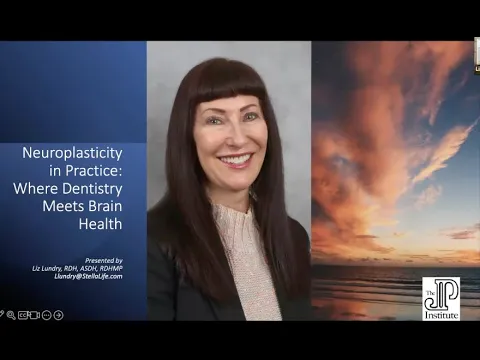
Hi everybody. I am Liz Laundry and today I'm going to be speaking to you about uh neuroplasticity in practice where dentistry needs brain health. So thank you all again for joining me today and I'm just going to carry on here. Great. So the learning objectives today is I'll be presenting how we can reduce the risk of cognitive decline. how common pathogens increase our risk of dementia and how we can coach our patients to reduce their risk. And I'm also going to be presenting information on current research that shows a protocol that can be used for prevention as well as reversal of dementia. Yes, it absolutely can be done. So, uh I as uh my disclosures here, I am a senior consultant with the JP Institute. I've been a coach with and in office training with the JP Institute for over 35 years. I'm also a senior product specialist and the clinical educator for Stella Life. And Stella Life is an amazing company. I had the opportunity to uh try the products as a clinical hygienist. I've been a hygienist since 1979, a really really long time. And um I actually Stella Life was part of the JP protocol uh before I even joined Stella Life. But after I had an opportunity to try with my patients and uh just saw the results from patients who had chronic conditions that we see all the time like zerostoia like implanis and just the way they healed I was just sold on it and started using it in my daily life as well as starting to work with stella life and our mission at Stella Life like yours is to improve lives as clinicians in dentistry we are saving lives every day right so we're able to do this with together with stell life in a way that is very comfortable for the patients. With these products, we can accelerate healing. Uh we help to also produce great analesia so we can reduce and oftenimes eliminate opioids altogether. So we've got hundreds of thousands of patients and thousands of doctors who if they're uh uh speaking and they teach courses, they share Stellive with their attendees just because of all the benefits they've seen for their own patients. So the JP Institute has been around for over 35 years and we're the first consulting company that really focuses on the hygiene department as well as training the entire team. So it's customized training. We provide ADACE. I still do that uh going to offices all over North America and uh we're able to uh go through a process where we change what we do as far as our communication and really linking the uh body health with the oral health and having the time to explain that to our patients. So uh we do this training in such a way so that the entire team is on the same page the doctors are supporting hygiene the hygiene are supporting restorative and everybody really supports each other so it's really a beautiful thing but uh with that we do workshops and again is doing customized in office training our founder Jan Lazarus an amazing hygienist is also the co-founder of AOS the American Academy for oral and systemic health and she has just done so much in her life to make people live more healthily and live longer and happier. So, uh when we look at what we happens when we go into a practice, we see optimization of the practice production. So, this is not about money. U this is the metrics of money are really telling you how many patients you're helping and you know how we're able to take them to another level of health. And when we had this implemented as a hygienist, it's great because I wasn't doing bloody proies anymore. And uh as we transition from being a proy uh driven practice to more of an oral systemic practice and putting patients into therapy early and then treating them to completion. So we're able to keep patients in remission much longer with this protocol and also not doing proies all day is very satisfying for us. Right? So it's a different approach of communication having the time to do that with your patients because we just generally have an hour with our patients. We can't do it all in an hour but this is a protocol that allows us to really change our relationship with the patients uh in getting educated uh giving education to them as they come in. So really we can help them accept treatment and to be very very healthy. So I have been a member of the American Academy for Oral and Systemic Health. I don't know if any of you on the call are today but I really urge you to check a OOSH out. They have great courses. They've been doing a webinar series with amazing speakers. I've learned so much, you know, from listening to AOSH and they have great events where we're were able to go see speakers such as uh Dr. Drs. Bale and Donine and others who are really doing so much to incorporate dentistry into uh overall care whether it's cardiology and this is a group of dentists, hygienists, myofunctional therapists, uh chiropractors there are all kinds of people who are part of aosh uh physicians myofunctional myofunctional I mentioned but also functional medicine doctors. So it does take a village and we can't do it all. we need to network with others to really care for our patients properly. So when we look at uh the topic of today's uh presentation about neuroplasticity, what neuroplasticity is is it's also known as neuroplasticity or brain plasticity. Bunch of tongue twisters there. It's the fundamental ability of the nervous system to change its structure and function in response to experience, learning or injury. So bottom line is our brains are continuing to have the ability to remold and to grow and to repair itself provided that the conditions are right. Providing that uh we're doing what we should be doing with our nutrition that our body chemistry is what it should be. And this uh is the research that we're seeing on this is really very incredible and it's very very hopeful. We can do so much. So when we look at dementia and we look at Alzheimer's a cognitive decline, it is a global epidemic. So every 3 seconds someone in the world develops dementia. When we look at the money spent uh the annual cost of dementia in the US is over 1.3 trillion and that is going to be going up hugely by 2030. And when we look at the growth of people with dementia looking at 55 million in 2019 and expecting to see 139 million in 2050, it's really tragic. And if someone does end up needing to be in a full care full-time facility, you know, in the final years of their life, the average cost of that is three $350,000. That could be someone's entire life savings if they even have that. So uh the pathology of Alzheimer's actually can start in your 20s and as we know that there are peropathogens as part of the cause of the development of cognitive decline. Uh we think about all of these kids that we see that have bleeding gums. We if we're testing we know that they have microbes like PJalis which is one of the major causes of dementia. So they are getting this download of this bacteria which is going to their brain starting at a very young age. So the progression of the disease does start very early on. It is a devastating disease. Uh if you have most of us I think I expect everybody on this call has either a family member or a friend or definitely patients you know who have dementia and it affects the whole family. It doesn't just affect that person. Of course, if we don't do something about it as a society and as health care providers, this is going to wipe out our Medicare system. And the average age of a dementia patient is 49 years. So, these are statistics that I learned not too long ago and was really quite amazed. So, it's always been considered hopeless once you have it. Mainstream medicine doesn't really have hope. There will never be a pill to cure Alzheimer's. It's multiffactorial just as periodonal disease is multiffactorial. Most any disease has more than one cause. So the devastation to the brain is is you know it is devastating and uh with that patients really can't function. They lose their memories, they lose their personalities and uh they no longer know who their loved ones are. So very sad. But the good news is there is a treatment and it has been proven to work. It was developed by Dr. Dale Bredesen and this is his recode protocol. He has written four books. His first one, the end of Alzheimer's, uh really talks about how dementia develops, all of the uh biochemical thing, biochemical things that happen, all the factors that are involved, and then he explains how you can actually treat it when you look at each of these factors and treat each of those conditions. So, there is a lot of testing involved. If you haven't read this book, it's actually a great read. You can read it in just a few hours and you can learn so much. So not just for our patients but for ourselves because you know we may have a genetic tendency to have dementia. So there are tests that we can uh take to see this because if we have for example the epoe4 gene there we our risk of de developing dementia is like 70%. So the sooner we know that, the sooner we can take action to prevent that from happening because it is preventable. So his most recent book, The Ageless Brain, again, an excellent read and really informative. So these are two of the books I'm going to be recommending. I'm going to be sharing some other books with you that are great reads, but have excellent information for our own lives and also for those of our patients. So you can actually hear an interview that I did with Dr. Dale Bredesen. If you go to stellaralife.com and go to the podcast, I have a series called the innovator series and I interview amazing people and doctors, hygienists, all kinds of people, researchers and doctors uh Dale Bredesen's interview was there. So I invite you to check that out. So he created Recode and he's been uh researching as a neuroscientist uh dementia for over 30 years. uh he has um developed this protocol he discovered the many root causes of Alzheimer's and it's a network insufficiency and has com uh com come up with this wonderful precision method protocol that identifies the root causes and once we identify them we can actually treat them. So recode stands for reversal of cognitive decline. He also has the precode protocol which is the prevention of cognitive decline and that's the program I'm on right now. So uh with the trials that were done this first clinical trial there was actually 84% improvement.
A part of this uh trial was actually done during the pandemic. So there were some issues with people actually following through. So there were 12% that declined. they probably didn't really do the program and 4% had no change. But the fact that 84% did improve is so encouraging. It's no longer a terminal disease and these are the root causes that Dr. Bredesen talks about. So you can see on the left side uh diabetes, you know, issues with uh blood sugar and I became a hygienist in 1979. And I've been taking health histories all these years and as the decades progressed it's like more and more people are diabetic. Haven't you noticed that? It's crazy. And the medications that people are taking. So that's a huge factor and it's so common in our society. Chronic inflammation. People are eating inflammatory foods. They're living an inflammatory lifestyle and most diseases are they do have an inflammatory component. uh gut dispiosis, the microbiome. This is an area of ongoing research. We're just learning about all the things these incredible bacteria do, the commensal bacteria that populate our gut, our skin, our mouth. They're everywhere and they each have really critically important jobs to do. And unfortunately, our lifestyle tends to wipe a lot of them out. So, we look at that. We have to look at whether or not people have herpes simplex. that also increases your risk. Heavy metals uh in the environment, toxins in the environment such as mold, uh micotoxins is also one of the great causes of dementia. It's very frequent that a patient who has Alzheimer's, any cognitive decline, has been exposed to black mold and has mcotoxins in their system. But without testing, you would never know that. You don't often have any symptoms. Maybe you feel tired, your brain's not working as well, and you think, "Oh, I'm just getting older. I didn't get enough sleep." But, you know, it could be that. So, also sleep, uh, we're not getting enough sleep. People don't breathe properly, airway, all of that, all of this comes to play. And of course, the nutrient deficiencies that most people suffer because they're not eating the right foods. So the treatment includes looking at all of those factors and then making lifestyle lifestyle choices and changes as well as treating each of these different conditions by doing a lot of testing to see what patients are deficient in uh what we need to beef up uh with their supplements and stress reduction. And we can do so much because a lot of what happens that is contributing to this and in many cases causing it is what's happening in their mouth. So inflammation is the root cause of Alzheimer's. So chronic inflammation again injures the neurons and synapses. The inflammation disrupts bla brain insulin signaling. So there's an energy star brain that can't support memory formation or repair. And then we've got the pro-inflammatory cytoines that trigger excess amaloid beta production. So this is basically the body's attempt to defend itself against these bacteria. So these amaloid plaques are deposited the amaloid proteins and they become the brain tangles because things kind of go haywire and this whole process ends up being destructive to the brain rather than being protective. And as you read the the books that I had mentioned, you'll learn about that. It's really fascinating. So we know that PG, FN, uh other oral microbiomes are uh sending inflammatory signals that reach the brain and perpetuate more neurodeeneration. And we can test for these biomic biomarkers, the interlucans, tumor necrosis factors, all of these uh are reversible. Again, once we decide and find out what is present, we can actually stop this action and reverse it. So there's no further degradation and in fact with that neuroplasticity the brain can repair itself. So we need to reduce inflammation, we need to reduce stress, we need to sleep more, we need to eat right. Uh sounds easy but we know it's not right. So you know how can we create value every day uh in our practices our especially our JP practices we're using technology we have training uh but we do advocate testing doing saliva testing whatever we can to find out what's happening with the patient and then making sure that everything we use is non-toxic to the patient and to the oral microbiome. So this really helps us to save lives. So our uh protocol with the JP Institute, I'm going to be sharing some of those elements and some of these things again you can you can take these to your office tomorrow and start implementing some of these things so that we can be more effective with helping our patients. So we want to treat periodonal disease early. The earlier we start that treatment, the the less treatment patients need, the more opportunity there is to really get control of it because there's no cure for periodonal disease. But we can really do so much to uh reduce that inflammatory response to reduce the inflammation and then to keep them in remission. But we need to treat them to completion. And this is where the testing comes in because without testing what bacteria are present, we're just looking at the appearance of their tissue and that can be deceiving. So, we've got the technology and we really should be using that as well as the great uh advanced technology we have for treating our patients. We've had ultrasonics for a while, which is fantastic. You know, are we using them adequately? Are we using different inserts and tips so we can access you know all of these areas subingly and are we spending enough time and are we really effective at removing the calculus and also the use of lasers, air polishers. There's some great technology out there that really can help us uh fight against this battle of the bofilm that we're battling every day. And then uh using products again that are not going to be toxic to the microbiome or to the patient. uh is the patient breathing well? We need to check their airway, ask them about their sleep, do they snore, and ask them a bit about what they're doing with their diet. So, we want to have time for this conversation and we can't do all of these things at once. So, it's a process and by getting them to come in for ongoing periodonal therapy, if there's any infection, we have an opportunity to do that. So with the uh 2017 world workshop, the American Academy of Periodontology is talking about our need to educate to communicate and to collaborate. So we collaborate with other specialists, right? But we also need to collaborate with our patient. The patient has a role in their own healing. They have that responsibility. So as we look at periodonal infection, it is an epidemic, right? And these are just some statistics taken from different studies done at different times. We do know it's probably the most prevalent chronic inflammatory disease in the US and in fact in the world. So you could look at different studies, but as I go and teach in different settings, whether it's in someone's office or in a workshop, I ask the clinicians, how many patients do you see in a day where you can clean their teeth or you can cut a prep and there's no bleeding? How many patients do you see every day with zero bleeding? So this is a really frustrated clinician going, "Ah, because it's like they're all bleeding. This was my life. It was one bleeding proy after another, you know, until I found a different way. So, as we see that, we know there's a wound site and bacteria is getting in there. It's getting to the bloodstream, going to the brain and all over the body. So, this is um an an infograph from the American Academy for Oral and Systemic Health with some statistics of what happens with perodonal disease. over 80% of the population does have perodonal disease. And we look at Alzheimer's, 70% are more likely to develop Alzheimer's in patients who have perodonal disease for more than 10 years. So that hugely increases their risk and we're on the front lines of detection and treatment of these conditions. So a pererryio is a systemic disease. We all know that that bacteria is getting into the bloodstream affecting the body. Uh here is a view of pingjavalis being incorporated into a cell and once it gets there it uh does what it does best which is actually controlling the genetic expression of other bacteria telling them what to do forming a biofilm. It even has the ability to change the genetic expression of a commensal bacteria to make it become a pathogenic bacteria. So P gingalis is a keystone pathogen having all of those functions and it is found in the brains of Alzheimer's patients. It does really stoic proteasis called ginger pain which degrade tow and significantly contribute to neuroinflammation. FN also again if we're testing we see that many of our pero patients have these pathogens. So with FN it's going to exacerbate the pathogen pathogenesis of Alzheimer's disease by contributing to the overgrowth of the micro gal cells the major immune system cells in the nervous system. So how do we detect perodonal disease? Uh we've been using the perodonal probe. Uh so that is 1936 technology. I learned that when I did an innovators interview with Dr. Tom Neighbors who was the founder of Oral DNA Labs. So I thought, wow, it's 1936 and that's what we're using. So when we use the probe, we're checking pocket depths. And when we look in this patient's mouth, we see that there's a 2 millimeter pocket there. Looks like there's some inflammation here and there, but the pocket depth seemed pretty good, at least in this area. But when the probe was actually swept through the sulcus, this was the bleeding that was there. So, this patient is not healthy even though they may have what we call uh normal pockets. So, we always like to tell I like to tell my patients to listen for the numbers when we're probing. Normal readings are 3 millimeters or less. Healthy gums don't bleed. You can adapt that and say that to your patients before you probe so they can listen, but we're saying normal readings are three or less, not healthy readings because they can be twos and they can be bleeding and then they're not healthy. So this patient sometimes there's no bleeding at all. Some of you who maybe have heard my presentations can recognize who this patient is. But this patient has no bleeding, no inflammation, a lot of attachment loss. Yes. But the pockets were basically twos and threes. Uh however, when the saliva testing was done and you can now see this is me. This is my first uh oral DNA test and I had tenderella present and if I hadn't tested, I never would have known. So I did have uh parodonal therapy uh not non-surgical periodonal therapy with a laser. Since then I have had parodonal surgery with uh root coverage and uh grafting. So but again it can be deceiving because when you look at my mouth it looks perfectly fine. So when do we test? I would submit that we should test all our patients when they come into our practice. But if you suspect there's periodal disease we absolutely should do that. So Oral DNA labs has some great as really a great organization for that. Simply perio as well. Uh they are wonderful for looking at the pathogens that we work with every day that we really want to really get control of. And Laura Hooper who is with Simply Perio is a hygienist and she's an incredible educator and we have a number of her uh presentations on stellarife.com. If you go to our website and go to the education page and then scroll down, you can see a few presentations from Laura Hooper and oftentimes when people are working with Simply Perry, she'll do the webinar with them. So, she's a great wealth of information and just a very dear person as well. So with lifestyle coaching as we talk to our patients and we see them of course we always look at perodonal disease but we can also and should be talking to them about detecting are they breathing properly? Do they have uh obstruction of the airway? Are they snoring? What about their food choices? Uh are they eating properly? Are they eating a lot of junk food? That's going to affect their healing. Are they sleeping well? Again, if we don't spend enough time in deep sleep, then our bodies don't regenerate. They don't repair themselves. And honestly, we are a sleepd deprived society. More on that later. But we also need to move. We are a very seditary society. Uh we need to get up. We need to get out. We need to use our bodies. You know, if you don't use it, you lose it. So, we're just machines, right? We have to keep ourselves in tune. So, airway, you got to breathe. If you don't breathe, you're not going to live as long, right? So it's very uh easy for us to check the airway when we have the patient sitting up just asking them to open their mouth just relaxed tongue open to see how much of the back of their mouth is obstructed. So can we see the uvula or is that completely covered? We can't see the soft pallet then we know that patient most likely has issues with breathing. And then we observe the patient as well like this child who is a mouth breather. You can see uh the face is already becoming elongated. So as patients continue to mouth breed, their faces do grow that way. You can see adults that have a very long face. And with these kids, a lot of times they'll have dark circles under their eyes because they're not sleeping well because they're not breathing very well during their sleep. They also tend to be really hyperactive. And what's sad is that people aren't aware of that. They aren't aware of that in the schools. So they think that kids have ADD or have some other learning issue, but they actually just can't breathe. So again, we're on the front lines of detecting that and educating the parents about that and giving them somewhere to go to get some help. So what do we do with that when people have problems with their airways? This is where going to an organization like AOSH and learning from others is fantastic. and also to create relationships with people within your own communities such as orthodontics that do specifically airway orthodontics. I recently finished orthodontics for the third time and this time it was with a doctor who was a professor at UCS staff dental school, Dr. Claire Ferrari and she does airway orthodontics. So with patients who like the picture of that child you just saw, they tend to get this long face because their arch is shaped like this. they really can't breathe. It's not functioning very well. So, we need to expand the arch. But the way that we need to do that is with a surgical implantation such as a MARPY because if you just use a palletal expander, you're just tipping the roots and you're not really expanding the arch. This actually goes into the septum and pushes the pallet apart. And it can be done on adults as it is in the image that you see right here. We also have to and can easily check to see if our patients are tongue tied. So with so many kids, a lot of times um people a woman will have a baby and she tries to breastfeed the baby and the baby's not latching on, you know, they're not able to feed and they're they're not growing. And if we can find out if that baby is tongue tied, that can be released. And then I've heard so many cases where once that is done the babies start thriving uh where before they can't eat properly. If we have a tongue tie we can't speak properly and we can't breathe properly either. And I've heard so many stories too uh from doctors and patients alike that once this tongue tie is released all the fascia in the body seem to relax like their shoulders relax. It's all connected. So it's critically important and again we're on the front lines of checking for this not only the labial the freedom under the tongue but also the attachment of the lip uh to the the uh tissue itself. Uh we see that around the midline sometimes where the freedom is right there and there's almost like a diasma between eight and nine. So we can check all of that and that all can be released. Myofunctional therapy is part of that procedure. uh there's myofunctional therapy that will reconstruct the face by developing the muscles doing specific exercises. So we can see this patient as she looked before she started and as she went through the therapy at the end you can see how her whole jawline looks different as well as her face. Her tongue now is functioning properly. She has a good lip seal which she didn't have initially and myofunctional therapy needs to be done before and then in conjunction and after a frenuloplasty or a frenctomy. So that goes uh as part of the treatment. But this is huge. So again if we have myofunctional therapist at our office fantastic if we don't we need to find some in our area and we need to network with them. And what about nutrition? Are we all eating the right foods? You know, you got to eat right, right? Do we all do that all the time? Probably not. If we do that most of the time, that's good. But so many of our patients, in fact, so much of the US population never do that. So, as we look at the American diet, I call it the death diet. So, we're not eating a lot of foods that are living things like plants or fruits. Uh, a lot of the foods that people are eating, and I see this when I go shopping, you know, whether it's Costco or any supermarket, people have their baskets laden with frozen foods, prepared foods. These foods are full of chemicals. If you look at a package, that's some rule for some people, and you can't read what the ingredients are, you put it back. You don't eat that, right? Uh so these people are eating mainly foods like this that have little or no nutritional value and they are inflammatory foods. So the stuff that we're supposed to be putting in our bodies to help us heal, to help us thrive, it's not happening. So there's this ongoing destruction. This is definitely one of the reasons we're seeing so much disease in our country, so much obesity, so much diabetes, and again more and more dementia. So sodas this is really like a poison when you look at the ingredients now most of them have corn syrup which is also causes very a lot of damage to your organs and there's no nutritional value in that at all and these drinks and a lot of these foods actually destroy the microbiome. So it reres havoc with your gut microbiome. People have digestive issues. They have leaky gut. They have all types of other diseases and it's linked with the poor quality of food that they are ingesting. And how important is that? It sounds very logical, right? Uh this book is a treasure. Uh it should be in every clinician's library. Actually, everybody should have this at home. It's a nutrition and physical degeneration written by Dr. Weston Price. This was written in the 1930s. Dr. Price was a dentist and he toured the world with his wife who was a nurse and they took images and they're all in this book, pictures of people in isolated communities in um you know remote islands, places in Australia, Africa, other places. They were isolated communities that mainly just ate what was in their area. And when you see the pictures, you see these people have no male occlusion. They have no periodonal disease. They had no tooth decay. As soon as they were introduced to western foods, namely sugar, because Dr. Price went back and he took pictures of their mouths later after that had happened. The same generation that used to have perfect teeth with no mal acclusion, no carries, no perodonal disease now had carries and periodonal disease and they were losing teeth and their children started having mal acclusion. So, we've always thought, oh, you know, your jaws too small, teeth are too big, you got crooked teeth, you go see the orthodontist. But actually, this is proving that if you're eating the right foods, that won't happen. So, this is happening because we're not eating the right foods, our bodies are not developing properly. So, uh it's an excellent book again, but definitely check it out. So, some of the things that we get when we eat these fruits and vegetables that are really important are these antioxidants. And antioxidants serve to uh uh protect us against free radicals which is basically an antio antioxidant that has lost some electrons. So the antioxidants repair those free radicals so they become antioxidants and then the antioxidants that donates that electron that one then becomes a free radical. So it's like a chain reaction. You need to have a good supply of these fruits and vegetables all the time so this repair can go on because there is the uh radicals the free radicals that occur just by the cellular functions that they do and if we get that out of control we have DNA damage the DNA starts replicating with errors and that's how we get cancers and other diseases. So the antioxidants help to reduce that damage and to prevent that. They prevent that oxidation from happening. So we do need to eat more plants. Uh we don't want our diets to be uh fruit heavy. Fruit is full of sugar. Yes, it's natural but it's still sugar. So you know kind of ballpark 70% vegetables, 30% fruit, something like that, but vegetable heavy. And depending on who you read, they'll tell you how many servings you should have a day. The NIH says five servings of vegetables and fruits every day. Other research say seven, some say nine. Anyway, you got to eat a lot of it. Like uh just kind of a guideline, half your plate should be vegetables uh when you're having dinner and try to eat fruits, you know, in small amounts through the day as well as other vegetables. Then you can actually do it. So, I just want to take give a shout out to the egg. The egg has had a bad rap over the last few decades because of the cholesterol thing, which now we know really was not really accurate. It was just like almost a means to provide more medication, which is sometimes needed, but we were taking the egg yolks out because we thought the cholesterol was too high. We were actually taking out one of the best sources of antioxidants around. So, no more white egg omelets. You know, use the whole egg. eat eggs, you know, on a regular basis. Uh, a great clean source of protein, but a wonderful source of antioxidants as well. So, sleep, again, if we're not sleeping, then we can't do the repair that we need. And this is another book that is a great read. It's fascinating. After you read the first page, it's like, okay, I got to put this book down and get to sleep because it tells you right away why and what happens during sleep and why it's so important. And this is another kind of a thing I do in workshops and when I teach courses. I go around the room and say, "How many of hours of sleep did you get last night?" And I hear, "Oh, oh, five hours or six hours." And some people are getting seven, eight, some getting nine hours, which is great. But, um, it's really incredibly important. And as I go to hear speakers talk about this, they all say the same thing. I have a non-negotiable sleep time. So, Dr. Walker talks about what happens during the sleep time and in the seventh and the eighth hour of sleep, your brain tissue actually shrinks down and the cerebral spinal fluid bathes your brain washing away the amaloid proteins that have accumulated there all day long. So we have this amazing mechanism that can help to reduce our dementia risk, but we don't use it because we're watching Netflix, we're binging Netflix or we're not getting enough rest. And another statistic I learned from this book is that when you get 5 hours of sleep for five nights in a row, your immune system is 50% less attract less effective. So again, really important. And what is the quality of the sleep? So patients again that are snoring that are mouth breathing they need to do a sleep study and they need to seek some help whether it's a electrical implant to help you know with stopping the snoring or it's a CPAP or it's a surgery to reconstruct their jaw so they're able to breathe. There are many different options out there but we need to have a referral source if we're not doing that ourselves. So, two individuals who are sleep deprivation casualties, uh, Ronald Reagan and Margaret Thatcher, both of them said when they were in office, they got about four hours of sleep a night. Both of them got dementia. So, again, it's a real life statistic and we see it all the time. And yes, you got to move. It's really important that each of us and our patients find something they like to do. You know, not everybody likes to go to the gym. Some people hate that, some people love it, but that's not what you necessarily have to do. You got to find your passion. For me, I do big yoga. I've been doing it for 18 years. It's fantastic. Uh but whether you're walking, whether you're running or doing a sport, playing tennis, playing soccer, whatever, doing something physical uh as much as you can. Doing it at least three, four times a week, you know, going for a nice brisk walk. uh anything that will help your body to move and also having some time to kind of meditate, you know, have some quiet time to yourself. These are all going to help us de-stress and help us feel better. But it's a matter of also helping encouraging our patients to do that. So, as dental professionals, we see them more often than they see their physicians. So the protocol in the JP protocol is down to a science where we're able to have enough time with the patient to educate them and to really help them on this road to better health. So we've taken the hygiene appointment and broken it down so we have some time for collection of data. Then we have time for case presentation and we tell the patient if they have a disease process going on or not and make recommendations of how many therapies they may need. We do customized treatment planning. So we don't try to fit everybody into four quads of replaning. It depends on the risk factors depends on level of bleeding. And if we see that there's infection, we actually really want to make sure that we test them to find out what bacteria is causing their infection. And we say all give all this information to the doctor when the doctor comes in. And the patients really respond well to this because they're involved in this. They actually watch us as we get the information and we tell them in the beginning of the appointment, we're doing things differently. So you can do this when you go back to work tomorrow. You may notice we're doing some things differently in your hygiene appointment today. And this is because of the most current medical research. We've learned so much more about how our body's health is affected by our oral health. So, the doctor is having me do some screenings today. So, we're going to be telling the patient about the fact that we're going to be doing a health history update, which is going to include talking to them about their family history. If there's a family history of diabetes, of cancer, or dementia, then if this patient does have periodal disease, and they're reluctant to have treatment, we're gonna say, "Hey, remember we talked about how, you know, your dad had Alzheimer's. So, you know, this is a risk factor for you. This is why it's so important for you to get your gum disease treated." So, the patient is involved in this process. We use a camera so they can see what we can see. And there's a whole protocol that we use so we're able to educate them as we go. and uh also doing the screenings that we do and informing them of what we see as we do that. So it is a whole different approach to patient care instead of just taking their health history and then diving into their mouth. So it's an all-encompassing approach once we actually do the treatment using whatever technologies we have. And one thing that we want to do as clinicians uh with Stella Life uh it's such a great product line to use because it is completely non-toxic and it is uh delicious as well. If you haven't tasted it tastes really good and that's really great for compliance. So this has been again part of the JP protocol for a very very long time. Uh these rinses can be used as a daily oral hygiene rinse. They also replace chlorhexidine without any staining and without any tox toxicity. They accelerate healing and I'm going to share some of the studies uh of that with you right now. So because the style is effective against PG and FN but it is not destroying the commensal bacteria. It promotes a healthy oral microbiome. Dr. Bredesen has made our style life forenses gels and our oral care products as part of the the Apollo health protocol in the reversal of dementia and the prevention of dementia. So with recode and with precode uh this is why we have teamed up with him. So this study done at ruters talks here about the uh bacteriacidal but then the bacteratic activity of cell life against these two major pathogens that are linked with dementia FN and PG. So after exposure FN is inactivated for 12 hours after using the Stellife rinse. PG is inactivated for 120 hours which is really great news because again we want to prevent these uh bacteria from impacting our bodies getting into our brains. Uh Dr. Bredesen talks about how when he was in medical school 30 years ago they were teaching that the brain was completely isolated and sterile but it's not. It's full of bacteria, viruses, all kinds of critters are in there. It's kind of like a swamp. So you know if we can do something for our patients that they can use on a daily basis we can reduce that risk and what this study also found that there was a lower toxicity toward the commensal bacteria that we need to preserve. So Stella does that as well. This is another reason Dr. Bredesen wanted to use Stella. But when we compare it to Listerine or chlorhexidine it has similar antimicrobial activity. So it is effective and against uh the bofilm disrupting the bofilm as these other chemicals do which are actually highly toxic to us. So the toxicity with these other rinses in this case oxytom which is a peroxide based rinse and chlorhexidine this study was done by Dr. um Dr. Scott Fro and he found that when nitric oxide test strips from Berkeley life were used when the patients were using the chlorhexodine or the oxytom there's no nitric oxide being produced but there was plenty of it when they were using the stellife rinse so the commensal bacteria that live on the dorsom of the tongue produce nitric oxide gas if you don't have that being produced your blood vessels become constricted nitric oxide keeps your blood vessels dilated So when the blood vessels become constricted, people's blood pressures go up. And studies have shown where you rinse with chlorhexidine twice in one day, blood pressures can go up by up to two and a half points. And that's also increasing a patient's heart attack risk. So again, we don't have to worry about that with Stella where we can safely disinfect without destroying the oral microbiome. And it's effective against other bacteria such as strep mutants. So patients that have zerostomia which a lot of these you know dementia patients do and u many of our other patients as well with one product they can hydrate as well as kill strep mutants. So they can lower their car's risk with one simple product. Again the rinse can be used in conjunction with surgeries or treatments. You can use it for subjingal irrigation and hygiene but can also be used safely as a daily rinse on an ongoing basis. So this study found that the stellife rinse actually accelerates fibroblast growth and that's uh here the fiberblast replicating with the stellife sample and you can see all these studies on stellife.com if you go to the research page. The chlorhexidine sample had nothing growing because it kills all of the fibroblasts. Chlorhexine kills osteoblasts as well. And here's the control with normal fibroblast activity. So again compared to saline to lististerine and to chlorhexidine the stell life was uh really much safer and helps to proliferate the fibroblast which is why we get more rapid healing. Uh so we it's all about having that healthy oral microbiome. So we have developed our stellite probiotics kit. We're the only company that has the gut and the oral probiotics in one box. The oral probiotics are also uh available as a standalone product. So, we have these uh essential 17 essential strains. They've been very carefully researched. And when you look at all of the benefits we get with reducing strep mutants, uh with reduction of mucusitis, uh reducing uh decay, helping with digestion, uh it's really a nice balance that we've created with this. And again, you would use that every day, taking a gut capsule and then allowing the lozenge to dissolve in the mouth. And this study was done with a patient who had four to six millimeter pockets, generalized bleeding, and all they did was give her the Stella Life probiotics kit. No other Stella Life products. They did SRPs as well. And the patient looked better after 6 weeks. Yes, they all look better 6 weeks after SRPs, but four months later, it got even better. And when you go look at this case on our website, you'll see the pocket depths and they went down to mainly threes and twos, and there was hardly any bleeding at all. So after 4 months, this proves that if we can populate the mouth with the good friendly commensal bacteria, there's no parking spot for the pathogenic bacteria to take hold. So it's just what we learned in microbiology. They can't create that substrate because there's no place for them to proliferate. So this is why we can disinfect with a rinse and then we can repopulate with a good commensal bacteria. Now, nutritionally, we are challenged. Uh, a lot of our patients, most of them are challenged, not eating the right foods. But even if you were, our environment is full of stress, full of toxins. A little nutritional supplement goes a long way. So, we've created Dentametica that can be used to boost patients vitamin D. If they're going to be getting implants, it's made to do that, but it also can be taken at half the dose as a daily supplement. So, it has everything you need to be healthy. And like all of our products, it's made in a good manufacturing practice, GMP certified facility, which means that it's overseen by the FDA. And that means that what you see here is actually in the capsule. There's not a lot of regulation on vitamin supplements in the US. So, you really don't know what you're getting. So, it's a clean formula. It's gluten-free. When you compare it to other uh companies, our D comes from Lyken. So, it's plant-based. is better absorbed than the sheep's wool that's usually used as a source. Our K2 is derived from chickpeas. It's usually derived from soybeans and they can be toxic to some people. People have soy allergies. And our B9 and 12 is already methylated. Some people can't methylate B. So if they don't get a methylated supplement, they can't absorb the B anyway and that costs more. We've included that in this formulation which is really affordably priced. And there's no magnesium sterate in the Stella formulation. So that is a a lubricant used to get the capsules to go through the equipment more easily in the factory. So we don't use that because many people are sensitive to that. So again, it's all made in the USA in a GMP facility. And you can take uh if you have good vitamin D levels, one with a morning meal, one with an evening meal, and you're getting all of the nutrients, antioxidants, and vitamins and minerals that you need to be healthy. So, I'd love to help you learn more about Stella Life and uh help you uh and your team uh learn about the benefits of this for your practice, uh for the level of care that you provide, and for the healing that you'll be able to provide for your patients. So, you can reach out to me. This is my direct line, my cell number, and this is my email. And you'll get complimentary products when we schedule a Stella Life live learning meeting. And if you want to learn more about the JP Institute, this is the contact information for my good friend and mentor Jan Lazarus. So, she can help you learn about that and do a complimentary practice profile analysis. So, feel free to reach out to her. And then you can be an Apollo health provider. There is an online training program that you can take at your own pace and then your office can also help to help people reverse uh dementia and also prevent getting it all together. So this is huge and the value of this for your practice is it adds credibility and you are specializing as a leader in treating and preventing and reversing cognitive decline. Again it's going to expand your role in total body health. It's going to make you really a really important practitioner within your community. Your practice will grow. You get better case acceptance when you do this. People want to get their dentistry done because they understand how this bacteria in those old amalgams or those old crowns is impacting their health. So you can also get a lot of referrals from medical colleagues as you do this. So it's good for your business, but the satisfaction of being to able to save people's lives in this way is incredible. So uh is some opportunity that you can take and if you want to do that, here is the QR code. uh you can re actually register to become an Apollo Health provider and if you use this QR code to do that then you'll get $200 uh training discount and Gerilyn Beers is the hygienist that works uh with Apollo Health. She's really smart lady uh really nice person as well and will help you with that to learn more. So, um, in conclusion, I want to, uh, just say that yes, we have a noble mission. We're here to save lives, right? And so, I was always in love with Mr. Spock. I grew up wa That's how old I am. I grew up watching the original Star Trek series. So, you know, I always had a crush on Mr. Spock. He was the science officer after all. Right. So, let's boldly go where we've not gone before to help our patients to live long and to prosper. So, thank you so much for your long attention. Do you have any questions for me? I think there is some questions in the chat. There are some questions in the chat. Liz, thank you so much. That was really informative. Um, so it looks like we have a lot of uh fans of Stella Life. And it looks like Carol, you had a question similar um to let's see here. Uh I I saw someone else asked this question, but they noticed that the rinses are a little bit hard to get because they're not on Amazon anymore. Can you share a little bit about how our clinicians can be offering our products to our patients and the benefits? Yes. So, we have uh the way that our products are manufactured, as I mentioned, the GMP facility, uh we're very selective about where they are uh made. So, as Stella Life use has grown, we are expanding the facilities. But in the meantime, with the growth, there's been a huge demand for Stella Life. So as we see that that's happening with our supply, it is not available on Amazon and even consumers are now not able to buy it direct from Stella Life because we want to make sure that we have it for our doctors who are using them for their surgeries who are their patients are relying on it. So these doctors are actually dispensing the products. So uh it can be very simple to just have it in the office. Uh, everything comes 12 to a case. Everything is up to a two-year shelf life. And our guarantee even covers replacing expired products because we're here to help people. And uh, but that's why you may not be able to get it on Amazon or again, even a single bottle, a consumer may not be able to get that if the supplies running low because we really want to make sure our clinicians have what they need. And Liz, if they do want to move forward and bring it into the practice um and you know selling our cases of 12 with a clinician discount, what steps would they take to be able to come on to the Stellife family? So is the best thing to do is to contact us. I gave you my information earlier. You can also go to stylelife.com and just call the customer service number and say that you're interested in learning more about that and then we will schedule a live learning uh for you and your team. Uh if you are in an area near one of us then we would do it live otherwise it would be over zoom and with that you can ask questions. We send you also a lot of support materials and complimentary products to try uh so that you can actually try these out yourself. Fantastic. Just a few more questions here. It looks like Judy Goldman had a question. When a patient comes in with a history of taking blood thinners, how do you approach testing? You still uh even though they're taking blood thinners, we're still going to do the saliva test. And that's really the best way because when in the past before we had that technology, I mean, you know, I've been doing this for like over 40 years. We didn't have any of that stuff. So if a patient's gums were bleeding then you know that was that was it. They had parodal disease or deeper pockets or inflammation but the bleeding was a key indicator. But with blood thinners they may be more prone to that. So this is where the saliva testing is more critical for those patients so you can really see what's happening. And then once we treat them we'll have the uh sample before the treatment so we know what we're dealing with. But then we need to retreat them after we've done the non-surgical periodonal therapy to see, you know, if we've really treated them to completion. And then we should check by retesting perhaps every year with some of these patients because life happens. They fall out of remission. So the bacteria comes and goes. Uh people may be looking good for a long time and then they get under stress and then their immune system is not functioning as it is and they get reinfected. So, this is why the testing is so important. Does that answer the question?
If there are any follow-up questions. Oh, it looks like Judy Goldman said yes. Okay, great. We we do have a question from Jeffrey Cheerio. Uh, do we receive CE credits for this webinar? You can answer that and then also share a little bit about the process on what they do get for joining us today. So, uh, today there'll be a complimentary product on now that you've completed the course, uh, that will be sent to you, I think. Um, we're getting all of the information on where to send that. Is that right, Rachel? So, there'll be a complimentary product sent to you. And thank you for for for listening in. And then, um, I'm sorry, can you ask me the other part? I I my my brain went forward. I have to go back. Sure. Sure. So there aren't CE credits assigned for this webinar, but you will receive complimentary product as we suggested on the registration form. Correct. So to be able to redeem that, I'm going to you can see Liz's email here. I also just put it in the chat. What we recommend you do is just send an email to Liz, give us your shipping information so that way we can make sure to get that over to you and get that ordered in um this week so you can have it early next week. Right. And we do have courses on our website and hopefully we'll be able to or offer CES in the near future. So, but there's a regulation of you know how much education is there and product stuff and all that. So, uh we will have that. But yes, we'll be happy to send you some some complimentary products and answer your questions about Stella Life. Fantastic. Well, that covers all of the questions that are in the chat. If anyone else has any questions, feel free to unmute yourself. This is a conversation. So, um, you know, take the liberty to ask your questions now while we have the expert on the line. Thank you. Thank you for your kindness there, Rachel. Anybody have any questions? Would love to talk to you.
All right. Okay. We'll keep this meeting open just a little bit longer so you're able to access Liz's email. As just a reminder, please just send her an email with your shipping information and we will get all of those uh fun products over to you. It looks like there's some singing of praises in the chat. Thank you. Really informative. Thank you so much. Great information. So, thank you very much, Liz. This webinar will also be available to review um in the next few days and we will follow up via email in case there's anything you'd like to reference. Thank you. I know you all work really hard, so I appreciate you taking your time after a long workday for joining us today. So, Thank you all so much.